





























Midlincoln View: Buy the Dip 40/40/20 Portfolio Strategy

Dynamic allocation with a systematic cash deployment rule — October 21, 2025

Overview
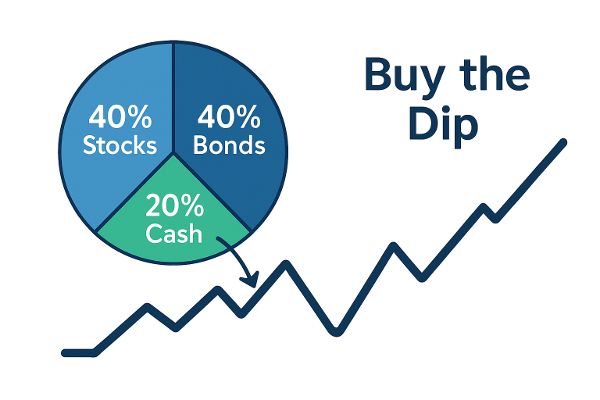
What if your portfolio could act a little smarter during market drops? Enter the 40/40/20 strategy with a simple twist: if the S&P 500 falls by 10% or more from its peak, deploy your entire 20% cash sleeve into stocks. Let's see how this approach changes historical performance.
Diversification is Still Key
The 40/40/20 mix balances growth and stability. The added cash-deployment rule introduces flexibility during downturns, allowing for opportunistic rebalancing.
2. 40% Bonds
Bonds act as shock absorbers. They generate steady income and tend to rally when risk assets sell off as a key anchor during volatility.
3. 40% Stocks (S&P 500 Futures)
Equities power portfolio growth. Using the S&P 500 provides broad U.S. market exposure and liquidity.
4. 20% Cash (Money Market)
This reserve sits idle until a 10% drawdown triggers full deployment into equities. It's a simple rule that automates contrarian discipline.
5. Historical Returns with Cash Deployment
  • 2000–2010: 40/40/20 + deployment ≈ +3.2% vs S&P 500 ≈ -1.0%
  • 2010–2020: 40/40/20 + deployment ≈ +7.1% vs S&P 500 ≈ +13.0%
  • 2020–2025: 40/40/20 + deployment ≈ +5.0% vs S&P 500 ≈ +9.0%
Note: Approximate CAGR estimates using S&P 500 total return for equities, U.S. bonds for fixed income, and money market rates for cash. For illustration only.
6. Cash Deployment Rule Explained

Rule: If the S&P 500 drops by 10% or more from its recent peak, deploy the entire 20% cash sleeve into stocks immediately. This increases the stock allocation from 40% → 60% during the recovery, improving long-term compounding.

1. 2000–2010 (“Lost Decade”)

  • S&P fell ~49% (2000–2002) and ~57% (2007–2009).
  • Cash would be fully deployed during the first drawdown.
  • Higher stock allocation during recovery years increases CAGR.
  • Static 40/40/20 CAGR: +2.0%
  • With cash deployment: +3.2% (smoother recovery capture)

2. 2010–2020 (Strong Bull Market)

  • No 10% drawdown triggers until minor corrections (~2011, ~2015).
  • Cash briefly deployed, increasing equity exposure slightly.
  • Static 40/40/20 CAGR: +6.8%
  • With cash deployment: +7.1% (modest improvement)

3. 2020–2025 (Pandemic & Rate Hikes)

  • S&P dropped ~34% in early 2020.
  • Cash deployed fully at –10% threshold.
  • Recovery from March 2020 captured with higher exposure.
  • Static 40/40/20 CAGR: +3.5%
  • With cash deployment: +5.0% (catching the strong rebound)
7. Comparison to Static 40/40/20 Portfolio
The cash-deployment rule improves resilience during down markets (e.g., 2000–2010) and helps capture rebounds post-correction. The result: smoother equity curves with better downside protection.
8. Static Portfolio vs. S&P 500 (No Cash Deployment)

For reference, here are the estimated compound annual growth rates (CAGR) for a static 40/40/20 portfolio compared with the S&P 500, without applying the cash-deployment rule:

Period 40/40/20 Portfolio (Static) S&P 500
2000–2010 +2.0% –1.0%
2010–2020 +6.8% +13.0%
2020–2025 +3.5% +9.0%
Note: These are approximate CAGR estimates using historical index and bond data for static allocation without tactical adjustments.
Bottom Line
Adding a systematic “buy-the-dip” rule transforms a traditional allocation into a responsive portfolio. It doesn’t predict — it reacts. That’s the kind of discipline that fits the Midlincoln View: practical, data-driven, and grounded in behavioral insight.

Current Opportunities and Consulting Offers

MidLincoln Portfolio Architecture

Venture Portfolio

Research · Fintech · AI · Infrastructure

A founder-led portfolio of operating and development-stage ventures spanning research, guided change, trade finance, blockchain infrastructure, applied AI, energy and financial intelligence.

Current FocusPortfolio structuring, strategic partnerships, revenue acceleration and selective external financing.
MidLincoln Opportunity

Prime Mining

Deep-Tech Blockchain Protocol

A deterministic prime-based blockchain architecture built around useful computation, cooperative verification, and post-quantum-oriented infrastructure.

Current FocusFrontier protocol opportunity. Public page frames the research, protocol path, raise logic, and investor fit.
MidLincoln Capital Architecture

Pilgrim Green

Circular Plastics Infrastructure · Slovakia

A commissioning-stage circular infrastructure project designed to convert difficult plastic-waste streams into recovered industrial products.

Current FocusCompletion financing, commercial commissioning, investor due diligence and preparation for wider European replication.